Horsewood Official Website › Blog › Nettle Leaf Is Not Nettle Root, And It Matters Here
Nettle Leaf Is Not Nettle Root, And It Matters Here
One word on a panel decides whether a whole trial record applies, and almost nobody prints it.
- Nettle root and nettle leaf are different medicines. Same plant, separate literatures, different uses.
- The urological trials are all on root. Usually paired with saw palmetto, at 300 to 600 mg a day.
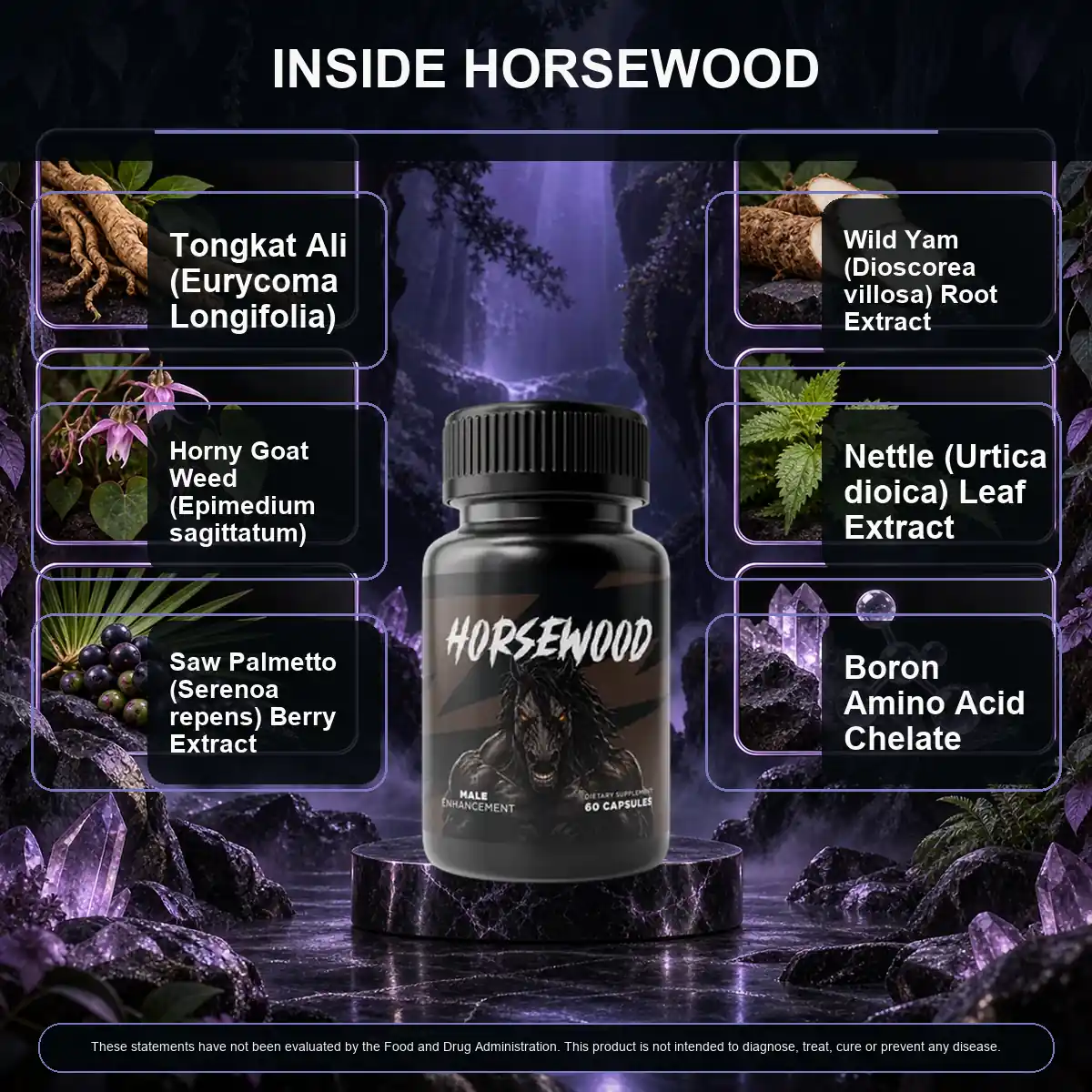
- This panel prints leaf, at 20 mg, and says so plainly.
- Leaf has its own evidence, mostly on joint pain and blood sugar.
- Printing the part is a mark in this label’s favour, even though the part it prints is the one with less to say here.
General information, not medical advice. Horsewood is a dietary supplement for healthy adults aged 18 and over. It is not a drug, it is not FDA-approved, and it is not intended to diagnose, treat, cure or prevent any disease. Persistent difficulty with erections is frequently the first visible sign of a vascular, hormonal or medication problem a clinician can measure and often treat. If it is new or persistent, see a doctor rather than a sales page, including this one. Speak to a pharmacist before adding anything to a prescription.
One plant, two medicines
Urtica dioica is the stinging nettle: a common perennial across Europe, Asia and North America, notorious for the hairs on its leaves and stems that deliver a dose of formic-acid-like irritants to anyone who brushes past it.
In herbal medicine it is not one remedy but two, and the split runs along the plant itself. The aerial parts, meaning the leaves and stems, are one preparation. The root is another. They contain different compounds in different proportions, they have been studied in different populations for different conditions, and the evidence for one says almost nothing about the other.
Pharmacopoeias keep them apart for exactly this reason: the Latin names are urticae folium for the leaf and urticae radix for the root. The comprehensive review of nettle root carries that second term in its own title, which is the clearest possible signal that the distinction is not pedantry invented for a blog post.
What nettle root has actually been tested for
The root is the urological one. It has been studied in men with benign prostatic hyperplasia, usually alongside a saw palmetto extract as a fixed combination, and usually at 300 to 600 mg a day.
The 2005 placebo-controlled multicentre trial is the representative example: a long-term, double-blind study of a sabal and urtica combination in men with lower urinary tract symptoms. The urticae radix review covers the wider body of that work and the proposed mechanisms, which involve lignans, sterols and effects on sex-hormone-binding globulin rather than anything hormonal in the way a supplement page usually implies.
It is worth noticing that this is also the literature in which saw palmetto looks strongest. The pairing is not a coincidence of shelf placement; it is how the trials were designed.
What nettle leaf has been tested for
The leaf has its own evidence and it points somewhere else entirely.
The best-known modern work is on inflammatory joint pain, where nettle leaf preparations have been studied topically and orally. Separately, and more relevantly to anybody reading a supplement label, a randomised double-blind placebo-controlled trial in type 2 diabetes tested nettle leaf extract on glycaemic control in patients already on medication.
That second trial is the one worth knowing about if you take this bottle, and not because it is a benefit. It is a reason to mention nettle leaf to anyone adjusting diabetes medication, and it is on the safety page for that reason rather than as a selling point.
| Root (urticae radix) | Leaf (urticae folium) | |
|---|---|---|
| Studied for | Urinary symptoms in benign prostatic hyperplasia | Joint pain, and blood glucose in type 2 diabetes |
| Typical studied amount | 300 to 600 mg a day | Varies; the diabetes trial used a standardised leaf extract |
| Usually tested | In a fixed combination with saw palmetto | On its own |
| Relevance to a vitality formula | Direct, through the urological route | Indirect at best |
| On the Horsewood panel | Not present | Present, at 20 mg |
Both columns describe real medicines with real evidence. Only one of them is the evidence a men's formula is reaching for when it lists nettle.
This label prints the plant part, which is why this article can be written
A bottle that says nettle and stops has told you less than it looks like it has. The full transcription is on the label page.
$49 to $79 a bottle · 60 days from purchase
Order HorsewoodWhich one this panel carries
Leaf. The Horsewood panel reads Nettle (Urtica dioica) Leaf Extract, 20 mg, and the manufacturer’s own listing graphic says the same thing.
There are two ways to read that and both are worth stating.
The critical reading
This is a men’s formula carrying saw palmetto and nettle, the classic urological pairing, and it has paired saw palmetto with the wrong nettle. The combination trials used root. At 20 mg of leaf, the row cannot be doing the job the pairing implies.
The fair reading
The label says LEAF. It did not have to. A very large number of products in this aisle print nettle with no part at all, which lets a reader assume root and quietly benefit from the urological literature without claiming it. This label closed that door itself, in print, on the panel.
That is a real piece of honesty and it is the same honesty that makes the 20 mg figure checkable in the first place. A label that tells you enough to criticise it is a better document than one that does not.
Why the distinction changes the answer
Consider the question a buyer actually has: does the nettle in this bottle do anything for urinary symptoms?
- If the row were root at 300 mg, the answer would be: possibly, in combination with an adequate saw palmetto extract, on the basis of a real trial record.
- If the row were root at 20 mg, the answer would be: no published basis, same problem as the saw palmetto row.
- The row is leaf at 20 mg, so the answer is: the literature being pointed at does not apply to this ingredient at all, before the amount is even considered.
Three quite different answers, and the only thing separating them is one word on a panel. That is why this article exists.
How to spot this on any label
Nettle is not the only ingredient where the plant part decides whether a literature applies. The habit generalises and it is one of the most useful things a reader can carry into this aisle.
- Nettle: root or leaf
- Ginseng: root, and which species
- Ashwagandha: root or root and leaf
- Maca: root, and which colour
- Saw palmetto: berry, and which extraction
- Epimedium: leaf, and which species
- Tongkat ali: root, and which ratio
Two follow-up questions turn that into a working method. First, does the label name the part? If not, assume the cheapest one. Second, does the literature you have in mind use that part? If not, the amount does not matter, because the evidence is not about this ingredient.
The nine-check version of this is on the checklist page, where naming the plant part is check three.
What a root formula would have looked like
It is worth sketching the alternative, because it shows how far this panel sits from the literature it is standing next to.
A formula built from the combination trials would carry a saw palmetto lipidosterolic extract at 320 mg and a nettle ROOT extract at 240 to 320 mg daily, and it would be aimed at urinary flow and symptom scores rather than at drive. That is roughly what the products used in the placebo-controlled multicentre trials contained, and it is how the urticae radix review describes the material that was tested.
Two of those figures are more than ten times what is on this panel, and the plant part on the nettle row is different. So a fair summary is that this bottle contains the two right plants in the wrong proportions and, on one of them, the wrong part.
Why a formulator might still build it this way
- Cost. 320 mg of a named saw palmetto extract plus 300 mg of nettle root is most of a capsule on its own, and it costs more than five 20 mg rows put together.
- Room. Seven rows totalling 118 mg fit comfortably beside a filler. Seven rows totalling 700 mg would need two capsules for the botanicals alone, before the shell and the flow agent.
- Recognition. Seven familiar names read as a fuller formula than two adequate ones, whatever the arithmetic says, and a panel is read in about four seconds.
None of that is a scandal. It is the ordinary economics of this shelf, and the only reason you can see it operating here is that the panel printed its numbers.
The verdict
The nettle row on this panel is honest and weak, in that order. It prints the plant part, which most of the aisle does not, and the part it prints is the one whose literature has little to say about why a man would buy this bottle.
It is a useful row for a different reason: it tells you something about how the formula was assembled. A panel carrying saw palmetto berry at 20 mg and nettle LEAF at 20 mg was not built from the combination trials. It was built from a list of recognisable names. Knowing that is worth more than any single milligram figure on it.
The whole panel is transcribed on the label page and every row is set against its own research on the ingredients page.
Sources for this page
- Chrubasik JE, Roufogalis BD, Wagner H, Chrubasik S. A comprehensive review on the stinging nettle effect and efficacy profiles. Part II: urticae radix. Phytomedicine. 2007;14(7-8):568-79. https://pubmed.ncbi.nlm.nih.gov/17509841/
- Lopatkin N, Sivkov A, Walther C, Schläfke S, Medvedev A, Avdeichuk J, Golubev G, Melnik K, Elenberger N, Engelmann U. Long-term efficacy and safety of a combination of sabal and urtica extract for lower urinary tract symptoms: a placebo-controlled, double-blind, multicenter trial. World J Urol. 2005;23(2):139-46. https://pubmed.ncbi.nlm.nih.gov/15928959/
- Kianbakht S, Khalighi-Sigaroodi F, Dabaghian FH. Improved glycemic control in patients with advanced type 2 diabetes mellitus taking Urtica dioica leaf extract: a randomized double-blind placebo-controlled clinical trial. Clin Lab. 2013;59(9-10):1071-6. https://pubmed.ncbi.nlm.nih.gov/24273930/
- Franco JV, Trivisonno L, Sgarbossa NJ, Alvez GA, Fieiras C, Escobar Liquitay CM, Jung JH. Serenoa repens for the treatment of lower urinary tract symptoms due to benign prostatic enlargement. Cochrane Database Syst Rev. 2023;6(6):CD001423. https://pubmed.ncbi.nlm.nih.gov/37345871/
- U.S. Food and Drug Administration. Questions and Answers on Dietary Supplements. https://www.fda.gov/food/information-consumers-using-dietary-supplements/questions-and-answers-dietary-supplements
Every page, every journal post, the bottle facts and the ingredients go through review by Dr. Kambiz Tajkarimi, MD before they ship. We write from the printed Horsewood label panel, the manufacturer’s own listing artwork and this desk’s stock paperwork, and we cite each study beside the amount that study actually used. This panel prints a milligram for all seven of its rows, which is better than most in this category, and it is why these articles can do arithmetic instead of guessing. Corrections are made on the page itself and the review date moves forward. Write to [email protected]. Last updated September 19, 2026.