Horsewood Official Website › Blog › The Seventh Ingredient: Why Two Sources Count Six
The Seventh Ingredient: Why Two Sources Count Six
The seventh row is sarsaparilla, and the two sources that omit it omit exactly the same one.
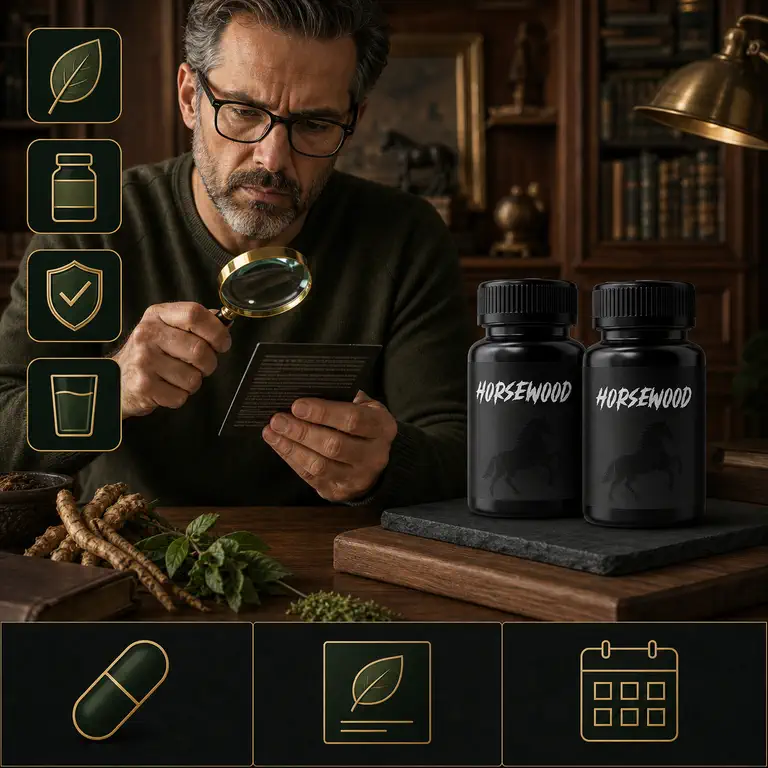
- The printed panel lists seven active rows. The seventh is sarsaparilla, Smilax ornata root extract, at 20 mg.
- Two sources count six. The named list this desk was sent, and the manufacturer’s own listing graphic, both omit it.
- Two sources count seven. The panel and the seller’s sales page.
- The panel wins, and this article explains why that is the right rule rather than a convenient one.
- Sarsaparilla is also the thinnest row on the panel. There is no human trial of this species at any amount.
General information, not medical advice. Horsewood is a dietary supplement for healthy adults aged 18 and over. It is not a drug, it is not FDA-approved, and it is not intended to diagnose, treat, cure or prevent any disease. Persistent difficulty with erections is frequently the first visible sign of a vascular, hormonal or medication problem a clinician can measure and often treat. If it is new or persistent, see a doctor rather than a sales page, including this one. Speak to a pharmacist before adding anything to a prescription.
Four sources, two answers
Every page on this website is written from four documents: the printed Supplement Facts panel on the bottle, the manufacturer’s listing artwork, this desk’s own supplier paperwork for lot HOR-26/HO-8034, and the seller’s page where the product is actually bought.
On almost everything those four agree. The serving is two capsules. A bottle holds sixty capsules and thirty servings. The guarantee runs sixty days. Where they disagree, it is usually about tone rather than fact.
On one question they split cleanly down the middle: how many ingredients are in this capsule.
Who says six and who says seven
| Source | What it is | How many it names |
|---|---|---|
| The Supplement Facts panel | Printed on the back of the bottle | Seven, with a milligram beside each |
| The seller’s sales page | Where the product is bought | Seven, named in the body copy |
| The manufacturer’s listing graphic | Marketing artwork shipped with the product | Six, drawn around the bottle |
| This desk’s supplier paperwork | The named list sent with the stock | Six, in a list |
Both of the six-item sources omit the same ingredient, which suggests one shared origin rather than two independent counts.
The omission is consistent, which is itself informative. The listing graphic and the named list leave out exactly the same row: sarsaparilla. Two documents making the same omission usually means one of them was copied from the other, or both from a common draft.
Why the panel is the tie-breaker
Two against two is not settled by counting. It is settled by asking which document is the one the law and the buyer both rely on, and that is not a close question.
- The panel is on the container you receive. Marketing artwork stays on a website; the panel arrives in your hand and can be checked against this page.
- The panel is the regulated statement of contents. A supplement in the United States is regulated as a food, and the FDA is explicit that the manufacturer is responsible for the truth of what its label says. The label is where that responsibility attaches.
- The panel carries the amounts. The six-item sources give no milligrams at all, so even if their count were right they would tell a reader less.
- A graphic is a design artefact. Six tidy boxes around a bottle is a layout decision, and a seventh name would have needed a redraw.
So this website counts seven, prints sarsaparilla beside the other six on the ingredients page, and states the discrepancy on the label page rather than quietly picking the tidier number.
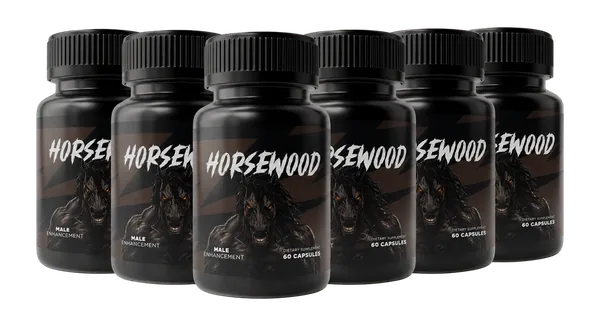
Seven rows, seven printed amounts
The whole panel is transcribed row by row, including the one two other sources leave out.
$49 to $79 a bottle · 60 days from purchase
Order HorsewoodWhat sarsaparilla actually is
Smilax is a genus of climbing, often thorny vines found across the tropics and subtropics. The root is the part used, and the name sarsaparilla covers several species that have been traded interchangeably for centuries, which is the beginning of the problem with its evidence.
This panel names Smilax ornata specifically, which is Jamaican sarsaparilla. Naming a species is, again, more information than many labels give, and it has an unfortunate consequence for anybody trying to look it up.
The historical reputation
Sarsaparilla arrived in European medicine in the sixteenth century as a treatment for syphilis, and spent the nineteenth as the basis of tonics and soft drinks. In the twentieth it acquired a reputation in bodybuilding circles for containing steroidal saponins that the body could supposedly convert into hormones. That last idea is the same chemical misunderstanding that attaches to wild yam, which also sits on this panel, and it is wrong for the same reason: a laboratory conversion is not a metabolic one.
The evidence, which is about a different species
Search the literature for Smilax and what comes back is substantial and almost entirely about other members of the genus.
The review of Smilax glabra in the American Journal of Chinese Medicine covers the ethnomedicine, phytochemistry and pharmacology of the species used in traditional Chinese medicine as tufuling, studied largely for inflammation and for gout. A 2024 review of Smilax china does the same job for another species.
Neither is Smilax ornata, and neither concerns anything this bottle is sold for. As far as this desk can establish, there is no human trial of Smilax ornata root extract at any amount, for any outcome.
That makes sarsaparilla the thinnest row on this panel by a clear margin. The honest word for it is not ineffective; it is unknown.
What to do with a discrepancy like this
A four-source disagreement is not a crisis. It is a routine feature of this aisle and there is a method for handling it.
If you are reading a label
- Find the Supplement Facts panel. Ignore the front of the bottle and ignore the website until you have read it.
- Count the rows yourself.
- If the marketing names something the panel does not, the panel is the answer. If the panel names something the marketing does not, the panel is still the answer.
If you have already bought it
Compare the bottle with the transcription on this site. If they differ, the bottle is right and this website is out of date; photograph the panel and the base and send it to [email protected]. Corrections are made on the page with the review date moved forward. The batch page covers the lot code and the seal.
The other traditional row, and the same misunderstanding
Sarsaparilla is not alone on this panel. Directly above it sits Wild Yam (Dioscorea villosa) Root Extract at 20 mg, and the two rows share a history and a chemical misunderstanding.
Wild yam root contains diosgenin, a steroidal sapogenin. In the 1940s a chemist worked out how to convert diosgenin into progesterone in a laboratory, and that synthesis underpinned the first oral contraceptives. It was genuinely important chemistry and it is why both plants acquired a hormonal reputation.
What it is not is metabolism. A human body has no pathway that performs that conversion. Eating diosgenin does not produce progesterone, testosterone or DHEA, because the steps the chemist used involve reagents and conditions that do not exist in a digestive tract.
What the one human trial found
A randomised controlled trial of a wild yam preparation measured menopausal symptoms, lipids and sex hormones in healthy women and found no change in the hormones it looked at. It is a small study, it is the clearest human evidence available on the question, and it points the same way the chemistry does.
The pharmacological review of diosgenin covers the wider research on the molecule, which is substantial and is about inflammation, lipids and cancer biology rather than about hormones in people.
So two of the seven rows on this panel, sarsaparilla and wild yam, sit there on the strength of a reputation that rests on a conversion nobody performs internally. That is not hidden and it is not unusual, and it is why the ingredients page sorts the seven rows by evidence rather than by prominence.
The verdict
Horsewood has seven ingredients. Two of the four documents describing it say six, they omit the same one, and the row they omit is the one with the least behind it.
It would have been easy to count six on this website. It matches the supplier paperwork, it matches the manufacturer’s own graphic, and nobody would have queried it. It would also have meant printing a number this desk knows to be wrong, on a website whose entire argument is that its numbers were read off the source.
So: seven, with the discrepancy on the page. The about page describes the method, and the reference guides apply the same approach to the category as a whole.
Sources for this page
- Hua S, Zhang Y, Liu J, Dong L, Huang J, Lin D, Fu X. Ethnomedicine, phytochemistry and pharmacology of Smilax glabra: an important traditional Chinese medicine. Am J Chin Med. 2018;46(2):261-297. https://pubmed.ncbi.nlm.nih.gov/29433390/
- Wang M, Bai QX, Zheng XX, Hu WJ, Wang S, Tang HP, Yu AQ, Yang BY, Kuang HX. Smilax china L.: a review of its botany, ethnopharmacology, phytochemistry, pharmacological activities, actual and potential applications. J Ethnopharmacol. 2024;318(Pt B):116992. https://pubmed.ncbi.nlm.nih.gov/37541403/
- Komesaroff PA, Black CV, Cable V, Sudhir K. Effects of wild yam extract on menopausal symptoms, lipids and sex hormones in healthy menopausal women. Climacteric. 2001;4(2):144-50. https://pubmed.ncbi.nlm.nih.gov/11428178/
- Parama D, Boruah M, Yachna K, Rana V, Banik K, Harsha C, Thakur KK, Dutta U, Arya A, Mao X, Ahn KS, Kunnumakkara AB. Diosgenin, a steroidal saponin, and its analogs: effective therapies against different chronic diseases. Life Sci. 2020;260:118182. https://pubmed.ncbi.nlm.nih.gov/32781063/
- U.S. Food and Drug Administration. Questions and Answers on Dietary Supplements. https://www.fda.gov/food/information-consumers-using-dietary-supplements/questions-and-answers-dietary-supplements
- U.S. Food and Drug Administration. Dietary Supplements. https://www.fda.gov/food/dietary-supplements
- National Center for Complementary and Integrative Health. Dietary and Herbal Supplements. https://www.nccih.nih.gov/health/dietary-and-herbal-supplements
Every page, every journal post, the bottle facts and the ingredients go through review by Dr. Kambiz Tajkarimi, MD before they ship. We write from the printed Horsewood label panel, the manufacturer’s own listing artwork and this desk’s stock paperwork, and we cite each study beside the amount that study actually used. This panel prints a milligram for all seven of its rows, which is better than most in this category, and it is why these articles can do arithmetic instead of guessing. Corrections are made on the page itself and the review date moves forward. Write to [email protected]. Last updated September 19, 2026.