Horsewood Official Website › Blog › What Is a Proprietary Blend, and Does Horsewood Use One?
What Is a Proprietary Blend, and Does Horsewood Use One?
Few label terms cause as much quiet frustration as proprietary blend. It sounds technical, and it often means you cannot see how much of each ingredient you are getting. Here is what the term means and where Horsewood stands.
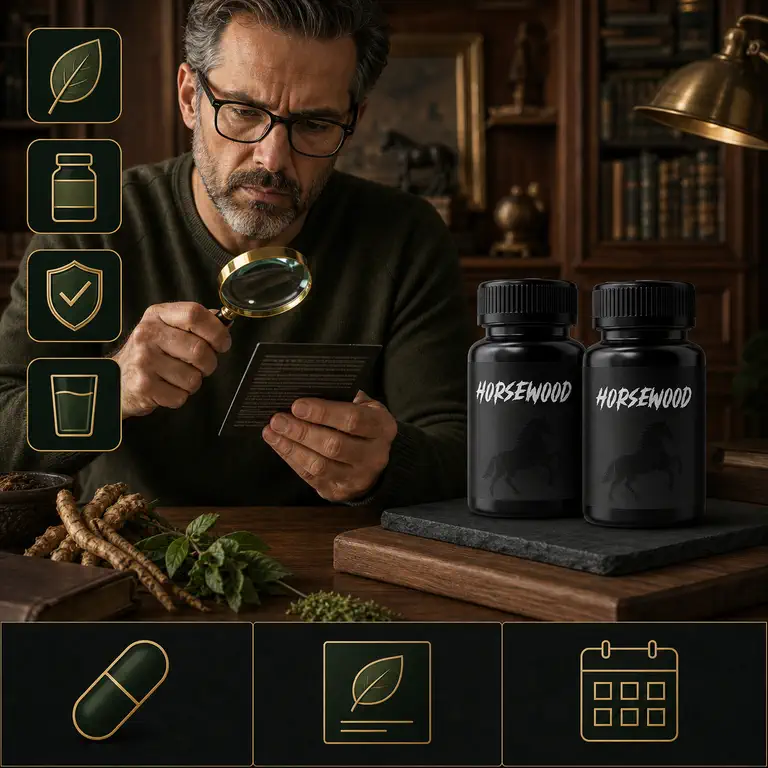
A proprietary blend lists a group of ingredients under one combined weight, so you cannot see each amount. Horsewood does not use one. Its panel prints an amount for all seven rows, adding up to 118 mg per serving. The one figure it leaves out is how much elemental boron sits inside the boron chelate.
General information, not medical advice. Horsewood is a dietary supplement for healthy adults aged 18 and over. It is not a drug and it is not FDA approved. No dietary supplement is. It is not meant to diagnose, treat, cure or prevent any disease. A change in sexual function that is new, sudden or getting worse can have a medical cause, so see a doctor about it. Ask a doctor or pharmacist before use if you take medicine or have a health condition.
What is a proprietary blend?
On a Supplement Facts panel, a proprietary blend is a group of ingredients shown together with a single total weight. The ingredients are listed, usually from the largest to the smallest, but their individual amounts are not given.
Imagine a blend of several herbs listed under one total weight. The label tells you the names and the total. It does not tell you whether one herb makes up almost all of that weight and another is a pinch. That is the whole point of the term. The recipe is treated as the maker's private property.
The word proprietary is not a sign of quality or of trouble by itself. It is a sign of how much you can check. With a blend, you can check very little.
Why do shoppers worry about blends?
The worry is simple. A supplement page may name an expensive or well-studied ingredient, and a blend can hide how little of it is inside. You cannot compare the amount to the amount used in research, because there is no amount to compare.
Blends also make it hard to compare two products. If one label prints a stated amount of a named herb and another lists the herb inside a blend, you cannot tell which one gives you more.
None of this means every blend is poor. It means a blend asks you to trust the maker where a printed amount would let you check.
Does Horsewood use a proprietary blend?
No. The Horsewood panel prints a milligram figure beside every one of its seven active rows. That is unusual in this category and it is the best thing about this label.
| Row | Amount | Note |
|---|---|---|
| Saw Palmetto Berry Extract | 20 mg | Printed |
| Wild Yam Root Extract | 20 mg | Printed |
| Sarsaparilla Root Extract | 20 mg | Printed |
| Nettle Leaf Extract | 20 mg | Printed |
| Boron Amino Acid Chelate | 20 mg | Printed, but elemental boron is not published |
| Tongkat Ali | 10 mg | From a 100:1 extract, stated as about 1000 mg of dry powder |
| Horny Goat Weed | 8 mg | From a 10:1 extract, stated as about 80 mg of dry leaf |
| Declared total | 118 mg | The seven amounts add up to this figure |
You can add the column yourself: 20 plus 20 plus 20 plus 20 plus 20 plus 10 plus 8 is 118. When a label's total equals the sum of its parts, nothing is being hidden inside a lump.
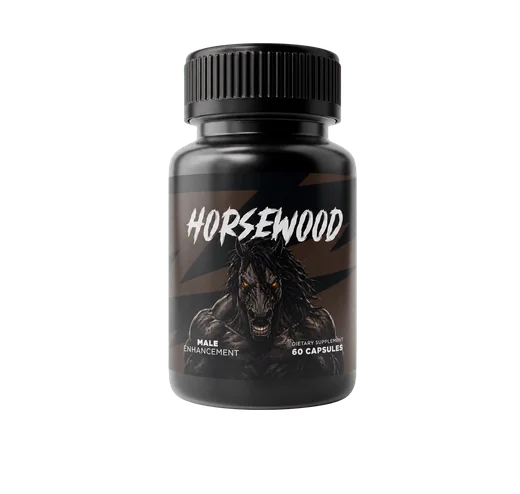
A label with every amount printed
You can compare each row with the research before you buy. The checkout shows the price and the 60-day guarantee too.
$49 to $79 a bottle at the seller’s checkout · 60 days from purchase to change your mind
See today’s price and guaranteeHorsewoodcare earns on orders placed through the checkout this website links to.
Is printing every amount enough?
No, and this is the second half of the story. A printed amount lets you check it against the research, and the check does not always flatter the label.
| Row | On this panel | What published research used |
|---|---|---|
| Tongkat ali | 10 mg of a 100:1 extract | Standardised extracts at stated daily amounts, so the units do not match |
| Horny goat weed | 8 mg of a 10:1 extract | No established human dose. The PDE5 work is in vitro |
| Saw palmetto | 20 mg | 320 mg a day of a lipidosterolic extract |
| Wild yam | 20 mg | One controlled human trial, with no hormone change |
| Sarsaparilla | 20 mg | No human trial of Smilax ornata at any dose |
| Nettle | 20 mg of leaf | 300 to 600 mg a day of root |
| Boron | 20 mg of chelate | 3 to 10 mg a day of elemental boron |
Saw palmetto is a good example. The big trials used 320 mg a day, and one of them also tested 640 mg and 960 mg. The label carries one sixteenth of the lowest studied amount. Nettle is a different case: the urological trials are on root, and this label prints leaf.
So the honest reading is two-sided. Horsewood is open about its amounts, and the amounts show that several rows sit well below the doses behind the research. A blend would have hidden both facts.
- A proprietary blend shows several ingredients under one total weight, without each amount.
- Horsewood does not use one. All seven active rows print an amount.
- The amounts are 20 mg on five rows, 10 mg on tongkat ali and 8 mg on horny goat weed, for 118 mg in all.
- Printed amounts show saw palmetto at one sixteenth of the lowest studied amount, and nettle as leaf rather than root.
- Elemental boron and the active content of the two extracts are not published.
- The certificate reference HOR-8034-26-HO is an identifier, not a laboratory report.
How do you compare two supplements when one hides its amounts?
This is a common question, and the method is the same each time.
- Write down every ingredient you can see on both labels.
- For each one, mark whether the amount is printed or hidden inside a blend total.
- For the printed ones, compare the number with what the research used. Check the unit: a ratio, a chelate and a standardised extract are not the same thing.
- For the hidden ones, ask the seller for the individual amounts. If the answer is no, you have learned something.
- Compare the total weight to the number of ingredients. A short total spread over many names means each one is small.
- Check the seller's terms: lot number, order ID, refund window and a phone number.
A label that prints every amount is not automatically better. It is easier to judge, and that is a real advantage.
What does the Horsewood label still not tell you?
Three things stay open even with every amount printed.
- Elemental boron. The row says 20 mg of chelate and the boron inside it is not published.
- Active content of the two extracts. A 100:1 or 10:1 ratio says how much raw material went in. It does not say how much active compound came out, and the active content is not published.
- Assayed content. We hold a certificate reference, HOR-8034-26-HO. It is an identifier, not a laboratory report, so we cannot confirm that any row assayed at its printed amount.
Naming these gaps is part of reading a label well. A page that told you every number was settled would be claiming more than the label does.
Frequently asked questions
What is a proprietary blend?
It is a group of ingredients listed under one combined weight, so you cannot see how much of each one is inside.
Does Horsewood use a proprietary blend?
No. The panel prints an amount for all seven active rows, and the declared total is 118 mg per serving.
Is a proprietary blend bad?
Not by definition. It means you can check less. A printed amount lets you compare the row with the research.
What does Horsewood still not publish?
It does not publish the elemental boron inside the 20 mg chelate, or the active content of the tongkat ali and horny goat weed extracts.
How can I compare two supplements when one hides amounts?
List each ingredient, mark which amounts are printed, compare printed ones with research doses, and ask the seller for the rest. Check the lot number and refund terms too.
Is the Horsewood certificate reference a lab report?
No. HOR-8034-26-HO is an identifier held in our stock paperwork. We do not have the report and do not claim its contents.
Our view
Printing every amount is the right instinct, and Horsewood does it. We give the label credit for that, and we show where the numbers, once printed, sit below the research. Both things are true at once.
The reader's job is to hold the two together. An open label is easier to judge, not automatically strong. Judge this one by the table above, by your own routine at week six, and by the refund terms.
If you take medicine or have a health condition, show the panel to a doctor or pharmacist. Every amount you need is on it.
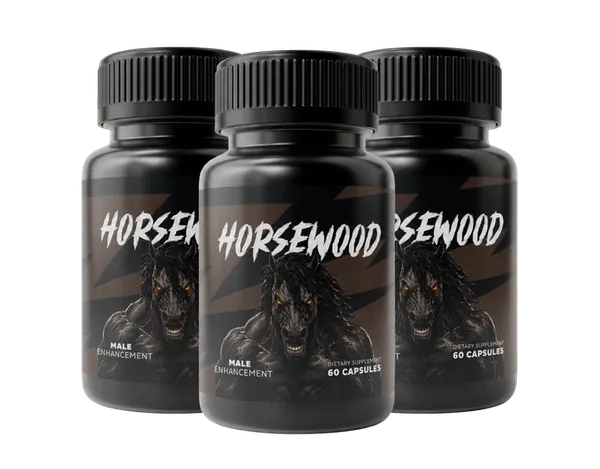
Check the numbers, then check the terms
If the panel looks fair to you, the official checkout shows today's price and guarantee in one place.
$49 to $79 a bottle at the seller’s checkout · 60 days from purchase to change your mind
See today’s price and guaranteeHorsewoodcare earns on orders placed through the checkout this website links to.
Sources for this page

Dr. Kambiz Tajkarimi, MD reviewed this page on October 16, 2026, as it reviews every page and post on this website. We write from the printed Horsewood label, the manufacturer’s own listing artwork and this desk’s stock paperwork. Where a figure is not published, we say “not published” and do not guess. Corrections are made on the page and the date moves forward. Write to [email protected]. Last updated October 16, 2026.