Horsewood Official Website › Blog › What Is In Horsewood? The Ingredients List And Supplement Facts, Row By Row
What Is In Horsewood? The Ingredients List And Supplement Facts, Row By Row
A supplement is easier to judge when you can read the label. Horsewood prints an amount for every active row, so this page reads them one at a time and flags the one number that is missing.
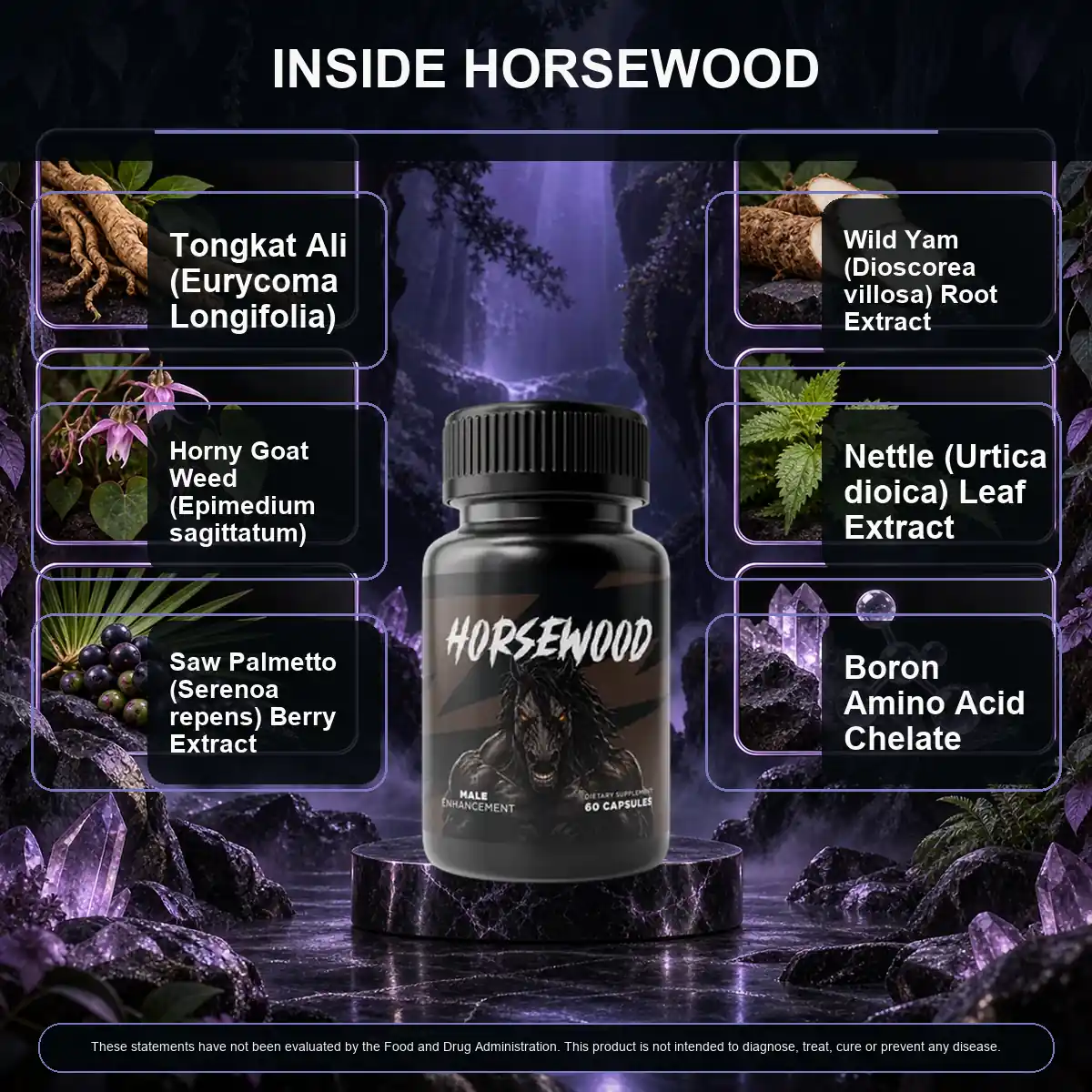
The Horsewood Supplement Facts panel lists seven active rows per two-capsule serving: five at 20 mg, tongkat ali at 10 mg and horny goat weed at 8 mg. The declared total is 118 mg. Other ingredients are microcrystalline cellulose, gelatin and magnesium stearate. Elemental boron is not published.
General information, not medical advice. Horsewood is a dietary supplement for healthy adults aged 18 and over. It is not a drug and it is not FDA approved. No dietary supplement is. It is not meant to diagnose, treat, cure or prevent any disease. A change in sexual function that is new, sudden or getting worse can have a medical cause, so see a doctor about it. Ask a doctor or pharmacist before use if you take medicine or have a health condition.
What is on the Horsewood Supplement Facts panel?
Here is the panel as printed, per serving of two capsules, with 30 servings in a bottle.
| Ingredient | Amount | Note |
|---|---|---|
| Saw Palmetto (Serenoa repens) Berry Extract | 20 mg | A berry extract |
| Wild Yam (Dioscorea villosa) Root Extract | 20 mg | A root extract |
| Sarsaparilla (Smilax ornata) Root Extract | 20 mg | The row some lists leave out |
| Nettle (Urtica dioica) Leaf Extract | 20 mg | Leaf, not root |
| Boron Amino Acid Chelate | 20 mg | Elemental boron not published |
| Tongkat Ali (Eurycoma Longifolia) | 10 mg | From a 100:1 extract |
| Horny Goat Weed (Epimedium sagittatum) | 8 mg | From a 10:1 extract |
| Declared total | 118 mg | Sum of the seven rows |
Add the rows and you get 118 mg. That is a very small pile of powder. Most of a capsule's volume is filler. The label revision is REV 11/25. If the bottle you receive shows a different panel, the bottle is right and this page is out of date.
What are the other ingredients in a Horsewood capsule?
The panel lists three: Microcrystalline Cellulose, Gelatin and Magnesium Stearate. Each has a plain job.
- Microcrystalline cellulose is the filler. Seven small extracts do not fill a capsule on their own.
- Gelatin is the shell. It comes from animals, which matters if you read the sales page's vegetarian roundel as a promise.
- Magnesium stearate helps powder flow through the filling machine.
None of the three is an active, and the panel lists no caffeine, yohimbine or synephrine. It also has no vitamins or minerals other than boron. So Horsewood is not a multivitamin and does not replace one.
How many ingredients does Horsewood have: six or seven?
Seven on the printed panel. Two other sources say six. The supplier's named list and the manufacturer's listing graphic both leave out sarsaparilla. The seller's sales page names seven.
This website counts seven. The reason is simple: the Supplement Facts panel is the statement printed on the container a buyer receives, and it is the only one of the four documents that carries amounts. The row that goes missing in the six-ingredient lists is Sarsaparilla (Smilax ornata) Root Extract at 20 mg, and no human trial of that species at any amount has been published.
Want to match this list to a real bottle?
The panel on the bottle is the final word, so compare it with this list when yours arrives and call the order desk if the two differ.
$49 to $79 a bottle at the seller’s checkout · 60 days from purchase to change your mind
See today’s price and guaranteeHorsewoodcare earns on orders placed through the checkout this website links to.
- Seven active rows, all with a printed milligram amount.
- Five rows are 20 mg, one is 10 mg and one is 8 mg.
- Declared total per serving: 118 mg.
- Two rows carry extract ratios: 100:1 for tongkat ali and 10:1 for horny goat weed.
- One figure is not published: how much elemental boron is inside the 20 mg chelate.
- The panel, not any web page, is the final word on what is in the bottle.
What do the 100:1 and 10:1 ratios mean?
A ratio tells you how much raw plant went into the extract. It does not tell you how much of the active compound came out.
| Row | Printed as | Meant to stand in for |
|---|---|---|
| Tongkat ali | 10 mg from a 100:1 extract | About 1000 mg of dry root powder |
| Horny goat weed | 8 mg from a 10:1 extract | About 80 mg of dry leaf powder |
So the label is open about concentration, which is more than many labels give. But a ratio is a manufacturing statement. It is not a standardised amount of an active. Trials usually report the weight of a standardised extract, so you cannot lay a ratio beside a trial and call the two equal.
What does the label leave out?
One figure: elemental boron. The row says 20 mg of boron amino acid chelate. A chelate is the mineral bound to an amino acid carrier, so the boron itself is only a fraction of that 20 mg. The panel does not print the fraction, and this website will not estimate it.
That gap matters for two reasons. Boron builds up in the body, so anyone who already takes it in another product should ask a pharmacist. And the studies that make boron interesting to men's formulas give elemental boron in single-digit milligrams, which this label cannot be matched against.
Two other gaps are worth knowing. The standardised active content of the two concentrated rows is not published. And the facility that ran this batch is not named in the papers this desk holds. This desk holds a certificate reference, HOR-8034-26-HO, but it is an identifier and not a laboratory report.
How do the label amounts compare with research amounts?
Quickly, because other posts go deeper. Saw palmetto studies used 320 mg a day, and the label has 20 mg. Nettle trials used 300 to 600 mg a day of root, and the label has 20 mg of leaf. Boron research talks about 3 to 10 mg a day of elemental boron. Tongkat ali has a 2022 meta-analysis, but with a different unit. Horny goat weed has no established human dose. Wild yam has one controlled trial with no hormone change. Sarsaparilla has no human trial.
This is why the row-by-row reading matters. A long list of famous plant names can look strong on a front label. The numbers tell you how much of each one is really there.
How do you check your own bottle against this list?
Four steps, all done on the bottle.
- Read the panel and count seven active rows.
- Check that the other ingredients line matches the three above.
- Find the lot and best-before on the base, where the bottle carries them. The stock this desk holds is lot HOR-26/HO-8034.
- Check the safety seal. The label says not to use the product if the seal is damaged or missing.
Frequently asked questions
What are the Horsewood ingredients?
Saw palmetto berry extract, wild yam root extract, sarsaparilla root extract, nettle leaf extract and boron amino acid chelate at 20 mg each, tongkat ali at 10 mg and horny goat weed at 8 mg.
What are the other ingredients in Horsewood?
Microcrystalline Cellulose, Gelatin and Magnesium Stearate. They are a filler, the capsule shell and a flow agent, and none of them is an active.
How much of each ingredient is in a serving?
The panel prints a milligram amount for all seven rows and a declared total of 118 mg for two capsules. The one figure it does not print is elemental boron.
Does Horsewood contain caffeine?
No. The panel lists no caffeine, yohimbine or synephrine.
Why do some lists show six ingredients?
The supplier's named list and the manufacturer's listing graphic both omit sarsaparilla. The printed panel lists it, so this website counts seven.
Is the formula a proprietary blend?
No. The panel prints each row's amount separately and then a declared total. That lets you compare each line with research, though the elemental boron figure is still not published.
Our view
The Horsewood label is more open than most. Every active row has a number, and that is the best thing about it. The same numbers also show that several rows sit below the amounts research used.
If you buy, use this list as your checklist the day the bottle arrives. If the panel, the lot or the seal does not match, say so to the order desk before you open it.
Compare it with your own list
If you have read the ingredients and they suit you, the checkout shows pack sizes, price and the refund route in one place.
$49 to $79 a bottle at the seller’s checkout · 60 days from purchase to change your mind
See today’s price and guaranteeHorsewoodcare earns on orders placed through the checkout this website links to.
Sources for this page

Dr. Kambiz Tajkarimi, MD reviewed this page on October 16, 2026, as it reviews every page and post on this website. We write from the printed Horsewood label, the manufacturer’s own listing artwork and this desk’s stock paperwork. Where a figure is not published, we say “not published” and do not guess. Corrections are made on the page and the date moves forward. Write to [email protected]. Last updated October 16, 2026.