Horsewood Official Website › Blog › What 20 Milligrams Of Saw Palmetto Can And Cannot Do
What 20 Milligrams Of Saw Palmetto Can And Cannot Do
Saw palmetto is the best studied plant on this panel and the studies are about urinary flow, at sixteen times the printed amount.
- Saw palmetto is the best studied plant on this panel. There is a Cochrane review and a large NIH-funded randomised trial.
- The studies are about urinary flow. Not about libido, not about erections, not about testosterone.
- The studied amount is 320 mg a day. This panel prints 20 mg, which is a sixteenth of it.
- The extract type matters as much as the amount. Almost all the positive work is on one hexanic lipidosterolic extract, and this panel does not name a type.
- It is still worth having on the label, and this article explains why that is not a contradiction.
General information, not medical advice. Horsewood is a dietary supplement for healthy adults aged 18 and over. It is not a drug, it is not FDA-approved, and it is not intended to diagnose, treat, cure or prevent any disease. Persistent difficulty with erections is frequently the first visible sign of a vascular, hormonal or medication problem a clinician can measure and often treat. If it is new or persistent, see a doctor rather than a sales page, including this one. Speak to a pharmacist before adding anything to a prescription.
The first row on the panel
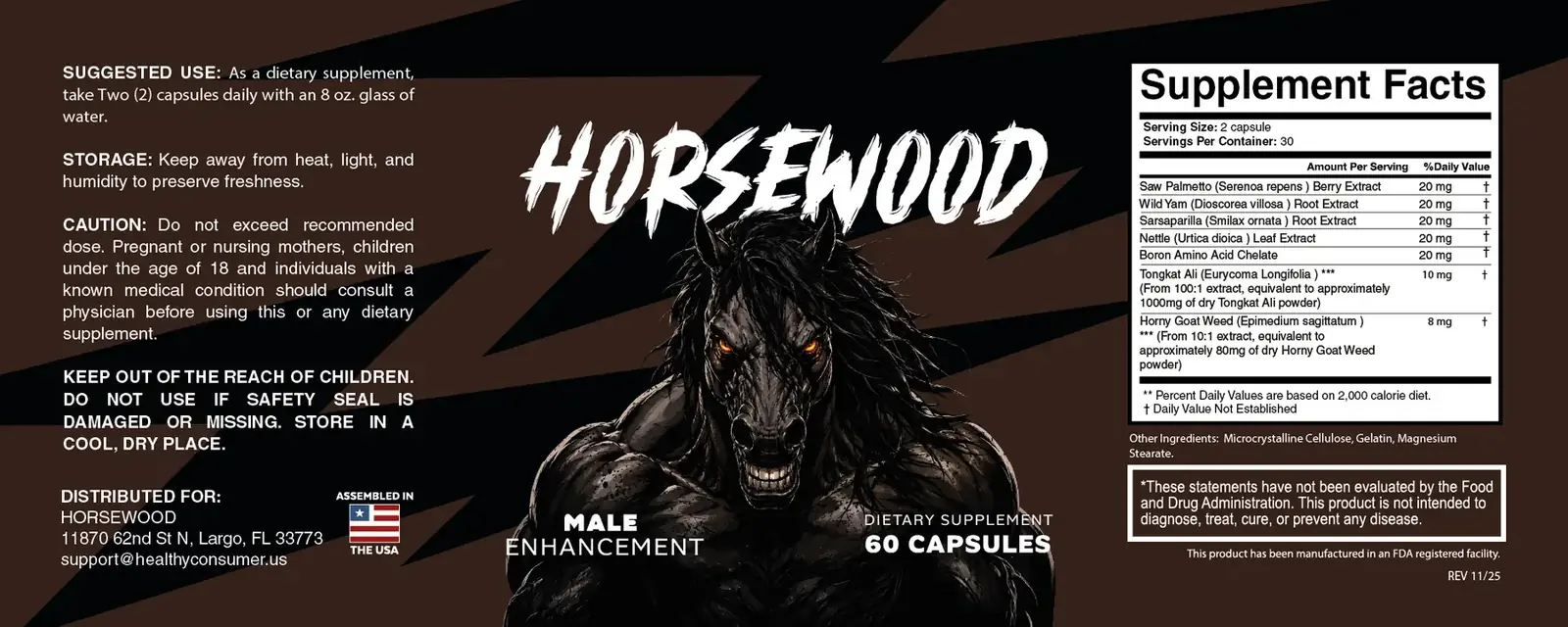
Read the Horsewood Supplement Facts panel from the top and the first thing you meet is Saw Palmetto (Serenoa repens) Berry Extract, 20 mg. It is one of five rows at that amount, it is printed clearly, and the label deserves credit for printing it at all: most bottles in this aisle bury the same ingredient inside a blend with a single combined weight.
Printing a number, though, invites arithmetic. Once a figure is on a label it can be compared with the figures in the research, and on this row that comparison is not flattering. This article does it in full, because the alternative is a page that prints the number and hopes nobody looks it up.
What saw palmetto actually is
Serenoa repens is a low, spreading palm that grows across the south-eastern United States, Florida especially. The part used is the ripe fruit, a dark berry roughly the size of an olive, and the medicinal preparations are lipid extracts of it: the fatty fraction, rich in free fatty acids, their esters, and small quantities of phytosterols such as beta-sitosterol.
That fatty composition is the reason extraction method matters here more than it does for most botanicals. A hexanic extract, an ethanolic extract and a supercritical carbon dioxide extract of the same berries are chemically different products, and they do not behave the same way in a trial. Keep that in mind; it returns later in this article and it is the most-skipped fact about this ingredient.
The trial record, and what it measured
Saw palmetto is the most heavily studied botanical on the Horsewood panel and it is not close. Two documents carry most of the weight.
The first is the 2023 Cochrane review, which pulled together the randomised evidence for Serenoa repens in lower urinary tract symptoms caused by benign prostatic enlargement. Its conclusion, in the plainest possible terms, is that the herb taken on its own provides little or no benefit for those symptoms.
The second is the CAMUS trial, published in JAMA in 2011. It was NIH-funded, it was properly randomised and blinded, and it escalated the dose rather than testing a single one: participants went to 320 mg a day, then 640, then 960. None of the three improved symptoms more than placebo.
There is a counterweight and it should be stated. A 2016 meta-analysis of the hexanic extract specifically reached a more favourable conclusion than the pooled literature does, which is the clearest single piece of evidence that the extract TYPE is doing real work in these results.
What none of this literature is about is sex. Not libido, not erections, not testosterone. Every trial named above measured urinary flow rate, symptom scores and prostate volume. NCCIH summarises it the same way: the evidence concerns benign prostatic hyperplasia, and evidence for other uses is insufficient.
320 milligrams against 20
Here is the arithmetic, and it is not complicated.
| Where | Daily amount | What was measured | Result |
|---|---|---|---|
| The Cochrane trials | 320 mg, typically | Urinary symptom scores, flow rate | Little or no benefit over placebo |
| CAMUS, arm one | 320 mg | AUA symptom index | No better than placebo |
| CAMUS, arm two | 640 mg | AUA symptom index | No better than placebo |
| CAMUS, arm three | 960 mg | AUA symptom index | No better than placebo |
| Horsewood | 20 mg | Nothing, on this product | No trial of this bottle exists |
The comparison is not about whether 20 mg is a lot or a little in the abstract. It is about whether the amount on this label is the amount anybody has ever studied.
Twenty milligrams is one sixteenth of the lowest amount in the table above. And the amount above it produced no benefit against placebo on the outcome it was designed to measure. Putting those two sentences together gives the honest position: there is no published basis for expecting 20 mg of saw palmetto to do anything, for urinary symptoms or for anything else.
It is worth being precise about what that does and does not mean. It does not mean the row is inert, because nobody has tested it. It means the row is untested, and untested is a different claim from ineffective. This website will not dress the first up as the second in either direction.
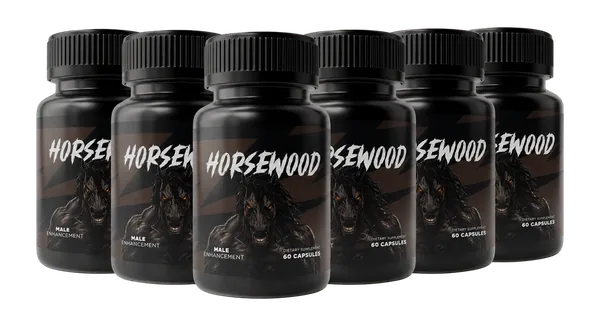
The Horsewood panel prints every one of its seven amounts
Which is why an article like this one can exist. Most labels in this aisle give a blend name and a combined weight, and there is nothing to check.
$49 to $79 a bottle · 60 days from purchase
Order HorsewoodThe part nobody prints: which extract
Go back to the chemistry for a moment. The positive results in this literature cluster around one specific preparation: a hexanic lipidosterolic extract, standardised, and studied as a named product. The 2016 meta-analysis is about that extract rather than about saw palmetto in general, and its more favourable conclusion is the reason the distinction matters.
The Horsewood panel says Saw Palmetto (Serenoa repens) Berry Extract. It does not say hexanic, it does not say a standardisation percentage, and it does not name a supplier preparation. That is normal for this aisle and it is a real gap, because it means the row cannot be matched to the one part of the literature that looks best.
What a better label would print
- The extraction solvent, or the supercritical method.
- A standardisation figure, usually total fatty acids as a percentage.
- The amount, which this label does give.
Two of those three are missing here. One of the three is present, which is one more than most of the shelf manages.
The PSA question, and a correction
A caution repeated across this whole category says saw palmetto can suppress a prostate-specific antigen reading and therefore mask a problem. It sounds plausible, because finasteride genuinely does lower PSA, and saw palmetto is often described as acting similarly.
NCCIH addresses it directly and the answer is no: saw palmetto does not appear to influence PSA readings, including at the higher amounts tested. This desk repeated the usual caution on an earlier draft of its own safety page and corrected it after reading the source.
What is worth raising with a clinician instead is bleeding. Saw palmetto has been associated with it, which matters if you take an anticoagulant or have surgery coming up. That note is on the safety page with the other six rows.
So why is it on a men’s vitality label at all?
Three reasons, and only one of them is about biology.
Recognition
Saw palmetto is the single most recognised botanical in men’s health. A buyer scanning a panel finds a name he has heard of, and that is worth something commercially whatever the amount beside it.
The prostate adjacency
Urinary symptoms and sexual function do travel together in middle-aged men, often because the same vascular and hormonal changes underlie both. A formula that addresses the urological side has a defensible reason to exist. It would need a urological amount to act on it, and 20 mg is not one.
The nettle pairing
The strongest urological evidence in this space is not saw palmetto alone. It is saw palmetto WITH nettle root, tested together as a fixed combination in trials such as the 2005 placebo-controlled multicentre study. This panel carries both plants, which looks like an informed piece of formulation until you notice that the nettle row is leaf rather than root. That is its own article and it is the next one on this blog.
The verdict
Saw palmetto belongs on a men’s panel and belongs there at 320 mg of a named extract, paired with nettle root, aimed at urinary symptoms, and described as such. What is on this label is the right plant at a sixteenth of the amount, unspecified as to extract, paired with the wrong part of the right second plant.
None of that makes Horsewood a bad buy. It makes this particular row a weak one, and the reason you can read that sentence here is that the label printed a number. A bottle that hides the same 20 mg inside a 500 mg proprietary blend gives you nothing to be disappointed by, and that is worse rather than better.
The full row-by-row comparison is on the ingredients page, the transcription of the panel is on the label page, and the three tiers are on the pricing page.
Sources for this page
- Franco JV, Trivisonno L, Sgarbossa NJ, Alvez GA, Fieiras C, Escobar Liquitay CM, Jung JH. Serenoa repens for the treatment of lower urinary tract symptoms due to benign prostatic enlargement. Cochrane Database Syst Rev. 2023;6(6):CD001423. https://pubmed.ncbi.nlm.nih.gov/37345871/
- Barry MJ, Meleth S, Lee JY, et al; Complementary and Alternative Medicine for Urological Symptoms (CAMUS) Study Group. Effect of increasing doses of saw palmetto extract on lower urinary tract symptoms: a randomized trial. JAMA. 2011;306(12):1344-51. https://pubmed.ncbi.nlm.nih.gov/21954478/
- Novara G, Giannarini G, Alcaraz A, Cózar-Olmo JM, Descazeaud A, Montorsi F, Ficarra V. Efficacy and safety of hexanic lipidosterolic extract of Serenoa repens (Permixon) in the treatment of lower urinary tract symptoms due to benign prostatic hyperplasia: systematic review and meta-analysis of randomized controlled trials. Eur Urol Focus. 2016;2(5):553-561. https://pubmed.ncbi.nlm.nih.gov/28723522/
- National Center for Complementary and Integrative Health. Saw palmetto: usefulness and safety. https://www.nccih.nih.gov/health/saw-palmetto
- Lopatkin N, Sivkov A, Walther C, Schläfke S, Medvedev A, Avdeichuk J, Golubev G, Melnik K, Elenberger N, Engelmann U. Long-term efficacy and safety of a combination of sabal and urtica extract for lower urinary tract symptoms: a placebo-controlled, double-blind, multicenter trial. World J Urol. 2005;23(2):139-46. https://pubmed.ncbi.nlm.nih.gov/15928959/
- U.S. Food and Drug Administration. Questions and Answers on Dietary Supplements. https://www.fda.gov/food/information-consumers-using-dietary-supplements/questions-and-answers-dietary-supplements

Every page, every journal post, the bottle facts and the ingredients go through review by Dr. Kambiz Tajkarimi, MD before they ship. We write from the printed Horsewood label panel, the manufacturer’s own listing artwork and this desk’s stock paperwork, and we cite each study beside the amount that study actually used. This panel prints a milligram for all seven of its rows, which is better than most in this category, and it is why these articles can do arithmetic instead of guessing. Corrections are made on the page itself and the review date moves forward. Write to [email protected]. Last updated September 19, 2026.